Autonomous Strike Submersible
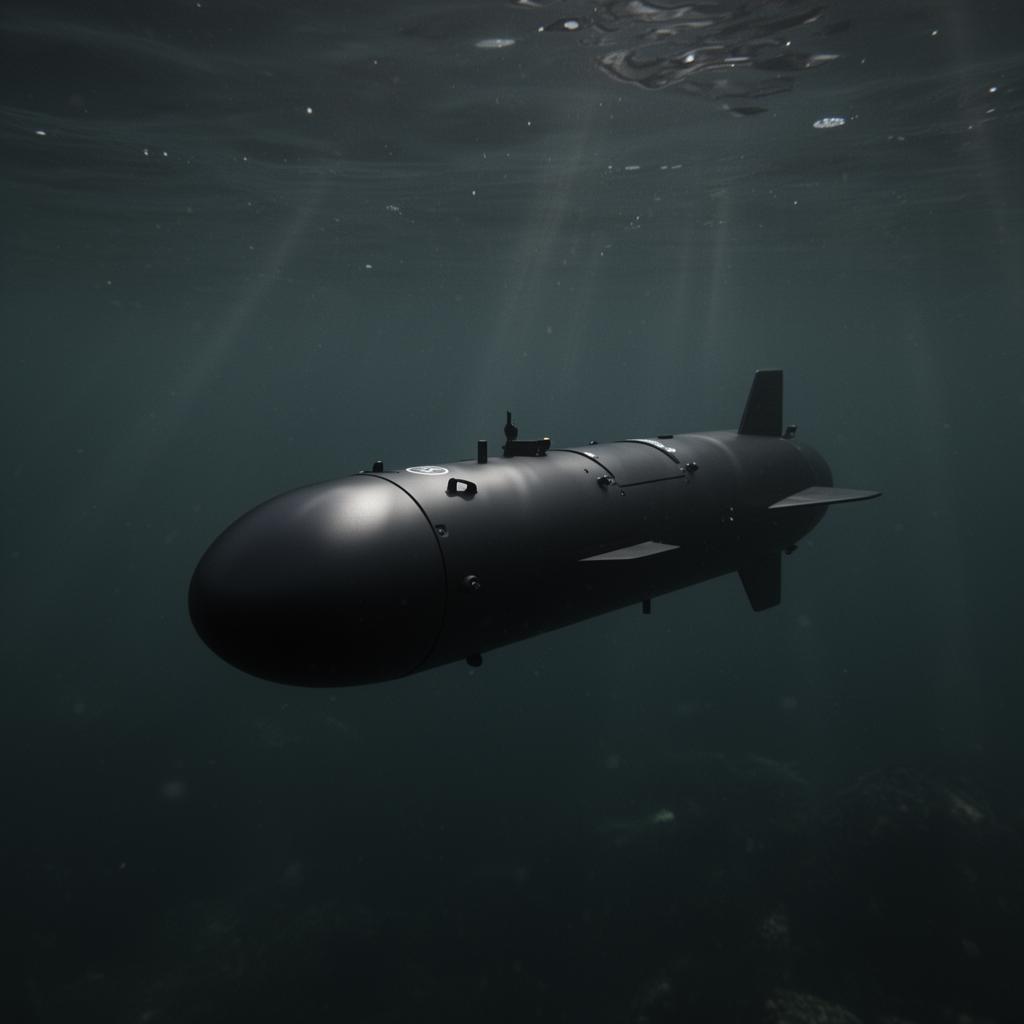
An unmanned underwater vehicle built to find, track and engage surface and sub-surface targets without putting a crew at sea.
Displacement
8 t submerged
Range
850 nm
PAYLOAD
1000 kg
Depth
30 m
The problem
What's failing today.
Modern anti-ship and anti-submarine missions still rely on large crewed platforms that are slow to position, expensive to risk and easy to hold at political risk. There is no scalable way to put a strike-capable presence under contested water.
The proposed solution
What the concept does.
A medium-displacement, fully autonomous submersible that can transit long distances on its own, loiter silently in a designated patrol box and engage surface or sub-surface targets with internally carried torpedoes or stand-off munitions.
Key design features
How the concept earns its place.
Feature · 01
Long-endurance propulsion
Lithium-polymer banks with an air-independent fuel cell range extender give it weeks on station between recoveries.
Feature · 02
Internal weapons bay
A flooded mid-body bay carries lightweight torpedoes or vertically launched stand-off effectors.
Feature · 03
Quiet-by-design hull
Pump-jet propulsor, rafted machinery and anechoic coatings keep the radiated signature below current detection thresholds.
Feature · 04
On-board autonomy
Classification and engagement decisions run on-board so missions continue through long communications blackouts.
Potential applications
Where it earns its place.
- Anti-ship interdiction in contested choke points
- Anti-submarine barrier patrols
- Covert surveillance of hostile coastlines
- Mine-laying and seabed effects
Future development
Where it goes next.
- Swarm coordination with smaller UUVs
- Submarine-launched and recovered variant
- Modular ISR-only mission pack for allied use
Platform evolution
Mission Variants
A single hullform supports several mission packs. Internal bays and signature treatment stay common; sensors and effectors change with the role.
Variant · 01
ASuWAnti-Surface Variant
Baseline strike configuration carrying lightweight torpedoes and vertically launched anti-ship effectors.
Key features
- Internal torpedo and VLS bay
- Passive over-the-horizon targeting
- Quiet-by-design hull treatment
Operational benefits
- Holds surface combatants at risk in contested choke points
- Removes the need to surge crewed submarines into political flashpoints
Variant · 02
ASWAnti-Submarine Variant
Configuration tuned for barrier patrols against hostile submarines, with towed array sonar and ASW weapons.
Key features
- Towed thin-line array
- Lightweight ASW torpedoes
- Cooperative engagement datalink
Operational benefits
- Sustains a sonar barrier without tying up frigates
- Multiplies the search rate of crewed ASW assets
Variant · 03
ISRISR & Seabed Survey Variant
Sensor-only configuration for long-duration surveillance of hostile coastlines and survey of strategic seabed infrastructure.
Key features
- Side-scan and multi-beam sonar suite
- Passive RF and acoustic intercept
- Bottom-resting silent loiter mode
Operational benefits
- Watches denied coastlines for weeks at a time
- Detects tampering with cables and pipelines early
Variant · 04
MIWMine Warfare Variant
Mine-laying and mine-countermeasure derivative that can seed or sweep contested water without risking a crewed minelayer.
Key features
- Modular mine carriage rack
- Mine-hunting sonar and disposal effector
- Pre-programmed lay patterns
Operational benefits
- Seeds defensive minefields covertly
- Clears chokepoints ahead of friendly traffic
Continue exploring