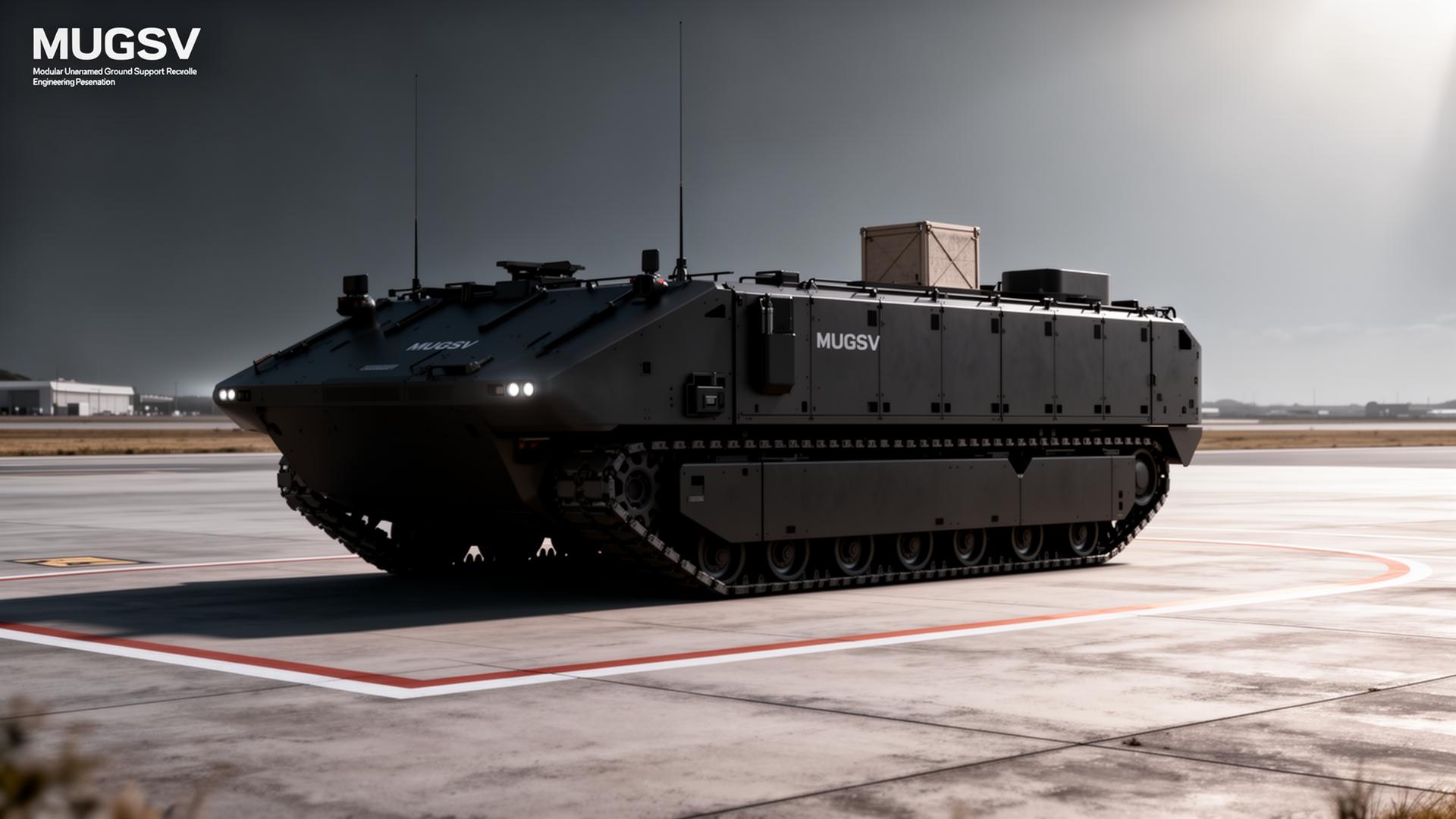
Modular Unmanned Ground Support Vehicle
A reconfigurable autonomous platform that takes humans out of the most exposed parts of the supply chain.
PAYLOAD
1000 kg
Range
420 km
Crew
0 (optionally manned)
Modules
6 baseline
The problem
What's failing today.
Last-mile logistics into contested or disaster-affected areas places crews in the most exposed leg of any operation. Existing platforms are single-purpose, slow to reconfigure, and expensive to lose.
The proposed solution
What the concept does.
MUGSV is a modular skateboard chassis with a standardised payload interface. The same vehicle can switch between cargo, casualty evacuation, power generation, and shelter deployment roles in the field, in minutes.
Key design features
How the concept earns its place.
Feature · 01
Standardised payload bays
ISO-style mounting points let any compatible module be swapped without tools or dedicated infrastructure.
Feature · 02
Hybrid-electric driveline
Range-extended electric drive enables silent-watch operation and reduces thermal signature on approach.
Feature · 03
Distributed autonomy
Each vehicle can operate solo, in a follow-the-leader convoy, or as a node in a larger logistics swarm.
Feature · 04
Casualty evacuation mode
A dedicated medical module brings two stabilised patients out of a hot zone without risking a crew.
Potential applications
Where it earns its place.
- Humanitarian aid distribution in disaster zones
- Forward resupply for dismounted teams
- Casualty evacuation from contested areas
- Mobile power and comms relay
Future development
Where it goes next.
- Aerial-deployable variant for rapid insertion
- Integration with the Drone Logistics Ecosystem for top-up resupply
- Cold-climate and amphibious sub-variants
Platform evolution
Platform Variants
MUGSV is not a single vehicle. It is a chassis and a payload standard that can be reconfigured for the mission in front of it. Five baseline variants share the same driveline, autonomy stack and service footprint.
Variant · 01
RECONReconnaissance Variant
Compact, low-profile configuration for scouting, route assessment, persistent observation and operation in hazardous environments.
Key features
- Mast-mounted EO/IR sensor head with laser rangefinder
- Acoustic and RF detection package
- Silent-watch battery pack for extended static observation
- Reduced thermal and visual signature kit
Operational benefits
- Pushes the sensor line forward without exposing a crew
- Holds an observation post for days without resupply
- Cues other variants and friendly units onto contacts early
Variant · 02
LOGLogistics Variant
Cargo-focused configuration designed to move supplies, batteries, water, medical consumables and mission-critical payloads to dismounted teams.
Key features
- Flat-bed payload deck with ISO lashing points
- Standard cargo cage and water bladder modules
- Battery and power-pack carriage with hot-swap interface
- Follow-the-leader convoy autonomy
Operational benefits
- Removes humans from the most exposed leg of the supply chain
- One operator can shepherd a multi-vehicle resupply train
- Common modules slot straight into the wider ecosystem
Variant · 03
MEDMedical Support Variant
Enclosed casualty support vehicle with rear loading ramp, stretcher accommodation, medical equipment storage and protected transport for casualties and medical supplies.
Key features
- Two NATO-standard stretcher positions with environmental control
- Powered rear ramp and overhead lift
- Onboard oxygen, suction and monitoring
- Hardened compartment with blast and fragmentation lining
Operational benefits
- Pulls casualties out of contested ground without risking a crewed ambulance
- Buys clinical time during the critical first hour
- Doubles as a forward treatment node when static
Variant · 04
SARSearch & Rescue Variant
Configuration optimised for collapsed structures, disaster zones and emergency response, carrying rescue equipment and survivor support supplies.
Key features
- Cutting, lifting and breaching toolset
- Thermal and acoustic survivor-detection sensors
- Floodlight mast and onboard generator
- Stowage for blankets, water and first-response kits
Operational benefits
- Enters unstable or contaminated structures ahead of rescuers
- Sustains a search line through the night without rotating crews
- Acts as a mobile power and lighting node on scene
Variant · 05
HUMHumanitarian Support Variant
Configuration designed for disaster relief, aid distribution, emergency shelter support and civilian assistance missions.
Key features
- Bulk water and food distribution modules
- Tent, blanket and shelter-kit carriage
- Public address and lighting package
- Civilian-friendly livery and low-aggression behaviour profile
Operational benefits
- Reaches isolated communities when road infrastructure fails
- Scales aid delivery without scaling exposed manpower
- Reinforces local responders rather than replacing them
Continue exploring