Long-Range Strike Drone
A low-cost, one-way fixed-wing drone built to reach deep targets and destroy them by kinetic impact.
Range
850 nm
PAYLOAD
1000 kg
Displacement
5 t submerged
Unit cost
Low
The problem
What's failing today.
Targets of strategic value sit far beyond the reach of tactical drones, while crewed strike aircraft and cruise missiles are scarce and expensive. There is no cheap, scalable way to hold distant targets at risk without consuming high-end inventory.
The proposed solution
What the concept does.
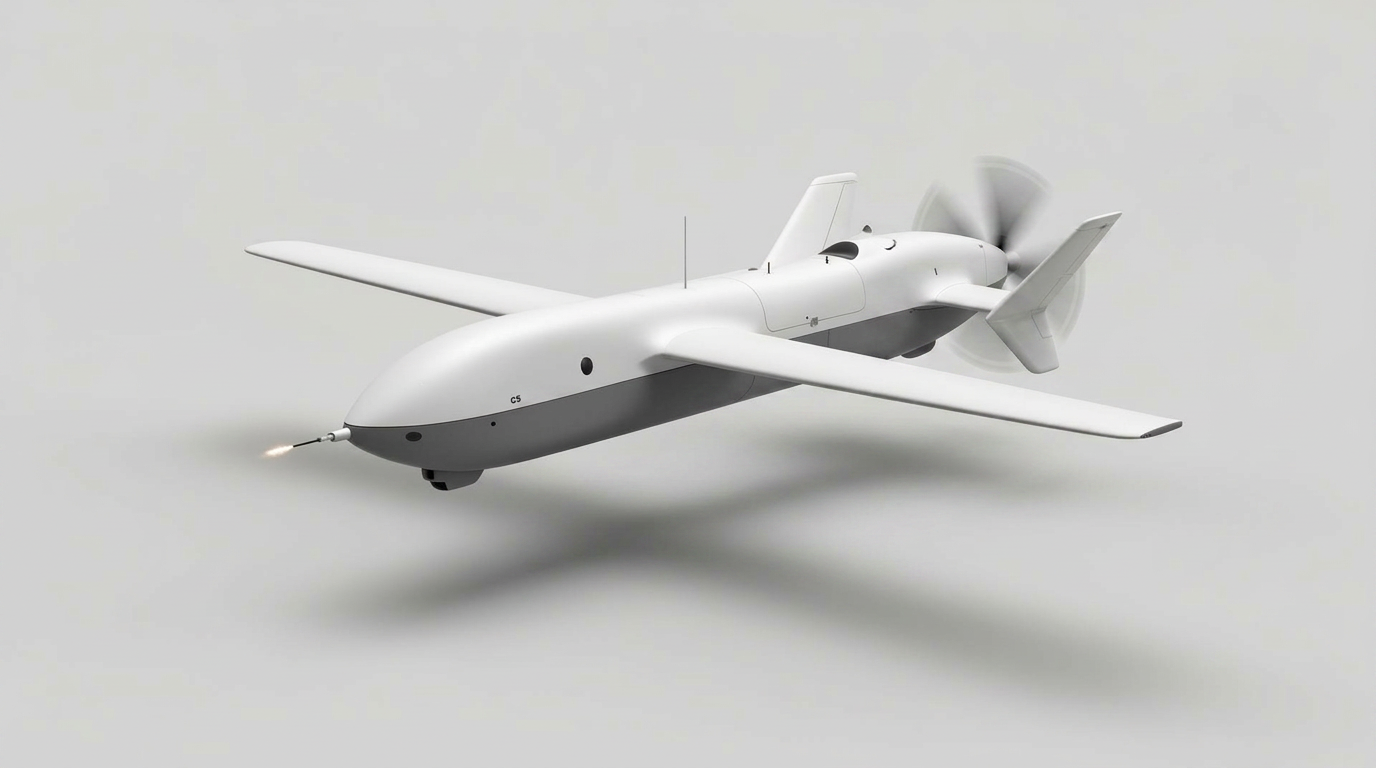
A small, low-cost fixed-wing drone sized between a tactical UAV and a cruise missile. Built around a simple airframe with a shaped-charge or blast-fragmentation warhead in the nose, it flies out to the target under autonomous guidance and destroys itself on impact. Cheap enough to lose, accurate enough to matter.
Key design features
How the concept earns its place.
Feature · 01
Long-range autonomy
Efficient high-aspect wing and a pusher propeller deliver hundreds of kilometres of range under GPS-denied navigation with inertial and terrain-matching backup.
Feature · 02
Terminal guidance
Electro-optical seeker with terminal pattern recognition lets the drone lock onto the target in the final minutes and correct its own impact point.
Feature · 03
Kinetic-impact warhead
A compact shaped-charge or blast-fragmentation warhead in the reinforced nose section destroys the target on impact without needing a separate release mechanism.
Feature · 04
Low unit cost
Commercial off-the-shelf airframe components, 3D-printed hardpoints and simple flight-control software keep the unit cost orders of magnitude below a cruise missile.
Potential applications
Where it earns its place.
- Deep precision strike against high-value fixed targets
- Time-urgent attacks on infrastructure and hardened positions
- Swarming saturation of air-defence sites
- Maritime interdiction against static or slow-moving vessels
Future development
Where it goes next.
- Swarm coordination for coordinated multi-axis attacks
- Hybrid propulsion with a rocket boost for sprint final approach
- Launch-tube deployable variant from ground vehicles or small craft
Platform evolution
Mission Variants
The strike drone is a common airframe and guidance core. The nose section and flight profile are swapped to specialise the drone for the target set without redesigning the platform.
Variant · 01
PENETRATIONAnti-Materiel Variant
Baseline configuration with a shaped-charge warhead in the nose for precision impact against hardened structures, vehicles and equipment.
Key features
- Reinforced nose section for penetration before detonation
- Electro-optical terminal seeker for pinpoint accuracy
- Autonomous waypoint and terrain-following navigation
Operational benefits
- Destroys high-value equipment at a fraction of the cost of a missile
- Small radar cross-section and low thermal signature make interception difficult
Variant · 02
AREAArea-Effect Variant
Nose section carries a blast-fragmentation warhead for soft targets, light vehicles and personnel in the open.
Key features
- Optimised fragmentation pattern for area coverage
- Loiter-and-dive attack profile for top-attack geometry
- Impact and proximity fusing options
Operational benefits
- Wide lethal footprint from a small, cheap airframe
- Top-attack geometry defeats light cover and vehicle roofs
Variant · 03
MARITIMEMaritime Interdiction Variant
Sea-skimming terminal approach with a semi-armour-piercing warhead for small boats, static vessels and harbour infrastructure.
Key features
- Radar altimeter for sea-skimming flight
- Salt-spray resistant nose and sensors
- Compact anti-ship warhead with delayed fuze
Operational benefits
- Holds small craft and coastal infrastructure at risk far from launch point
- Low visual and radar signature makes early warning difficult
Variant · 04
DECOYDecoy / Distraction Variant
Carries no warhead. Mimics the radar, thermal and acoustic signature of a larger threat to draw defensive fire and reveal enemy air-defence positions.
Key features
- Active radar enhancer and infrared flare payload
- Pre-programmed deceptive flight path
- Recovers or self-destructs after mission
Operational benefits
- Forces the enemy to reveal and expend interceptors
- Extremely low cost per sortie for high-volume harassment
Continue exploring